KATRAN · Engineering Notes

My Thoughts on the Search for the Ideal Long-Distance Casting Lead

Is there such a thing as a mathematically ideal lead shape for maximum casting distance? After twenty years of testing, I decided to start from the physics, not the shape.

Over the past twenty years, I have tested dozens of carp lead designs. Most manufacturers simply make small changes to existing shapes — essentially copying what is already on the market. One question has always stayed with me: is there such a thing as a mathematically ideal lead shape for maximum casting distance?

Until recently, that question was almost impossible to answer. Today, artificial intelligence, computer simulation and engineering analysis let us approach it from a completely new angle. So instead of starting with the shape itself, I decided to begin with something far more important: what actually happens to a lead during a cast?
The mistake

Most Anglers Imagine the Flight Incorrectly

Most people picture a lead flying through the air like a bullet. In reality, the process is far more complex. A casting lead passes through three completely different phases of flight, and a different physical force dominates each of them. If we are truly searching for the perfect lead, its shape has to perform well through all three.

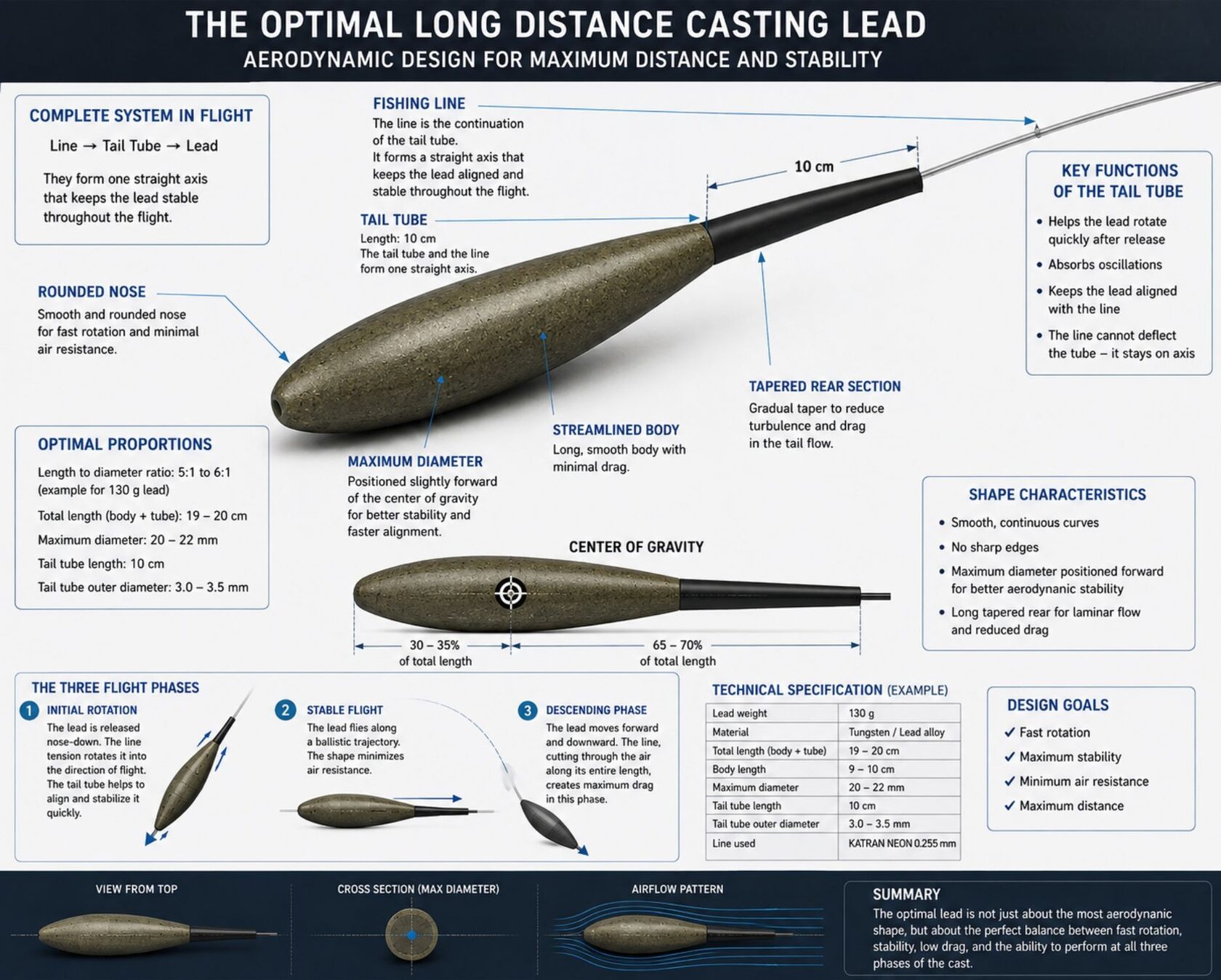
Infographic: the three phases of a casting lead's flight
The three phases of a cast — each governed by a different force.
Phase 01 · Rotation & stabilisation

Initial Rotation and Stabilisation

Before the cast, the lead hangs vertically. The line is attached at the top, the rounded nose points down. The moment it is released, the lead accelerates hard and climbs at roughly 45 degrees — and this is the most critical moment of the whole cast.

Tension in the line immediately rotates the lead into the direction of flight. The rigid tail tube does two jobs here: it turns the lead into its correct aerodynamic position as fast as possible, and it damps out the unwanted oscillations that appear right after release.

Once that happens, the line becomes a natural continuation of the tail tube. Line, rigid tube and lead form one straight axis. That alignment keeps the lead stable and stops the tube from deflecting off the trajectory.

Phase 02 · Ballistic flight

Stable Ballistic Flight

Once stabilised, the lead enters the longest and fastest part of its journey, following a ballistic trajectory while line keeps leaving the reel. Here the goal of the shape is simple: the lowest possible aerodynamic drag.

Fd = ½·ρ··Cd·A
ρ = air density · V = velocity of the lead · Cd = drag coefficient · A = frontal cross-sectional area.

The equation shows that drag rises with the square of velocity. That is why the first seconds of flight matter so much: every small reduction in drag at high speed preserves energy for the rest of the cast.

Phase 03 · The overlooked part

The Most Overlooked Part of the Cast

As the lead reaches the top of its trajectory, it starts moving both forward and downward. Most anglers keep watching the lead — but something more important is happening: the entire airborne length of the line is now moving forward while descending through the air.

In effect, the line cuts through a large volume of air along its whole length. The longer the cast, the more line hangs in the air, and the larger the total aerodynamic resistance becomes.

With KATRAN NEON monofilament at 0.255 mm and a distance of around 200 metres, the lead has to pull the maximum length of line during that final descending phase. Because the line moves forward and downward at once, it cuts through the full thickness of the surrounding air and produces its greatest braking effect right here. For me, this third phase holds one of the biggest opportunities for improving distance.

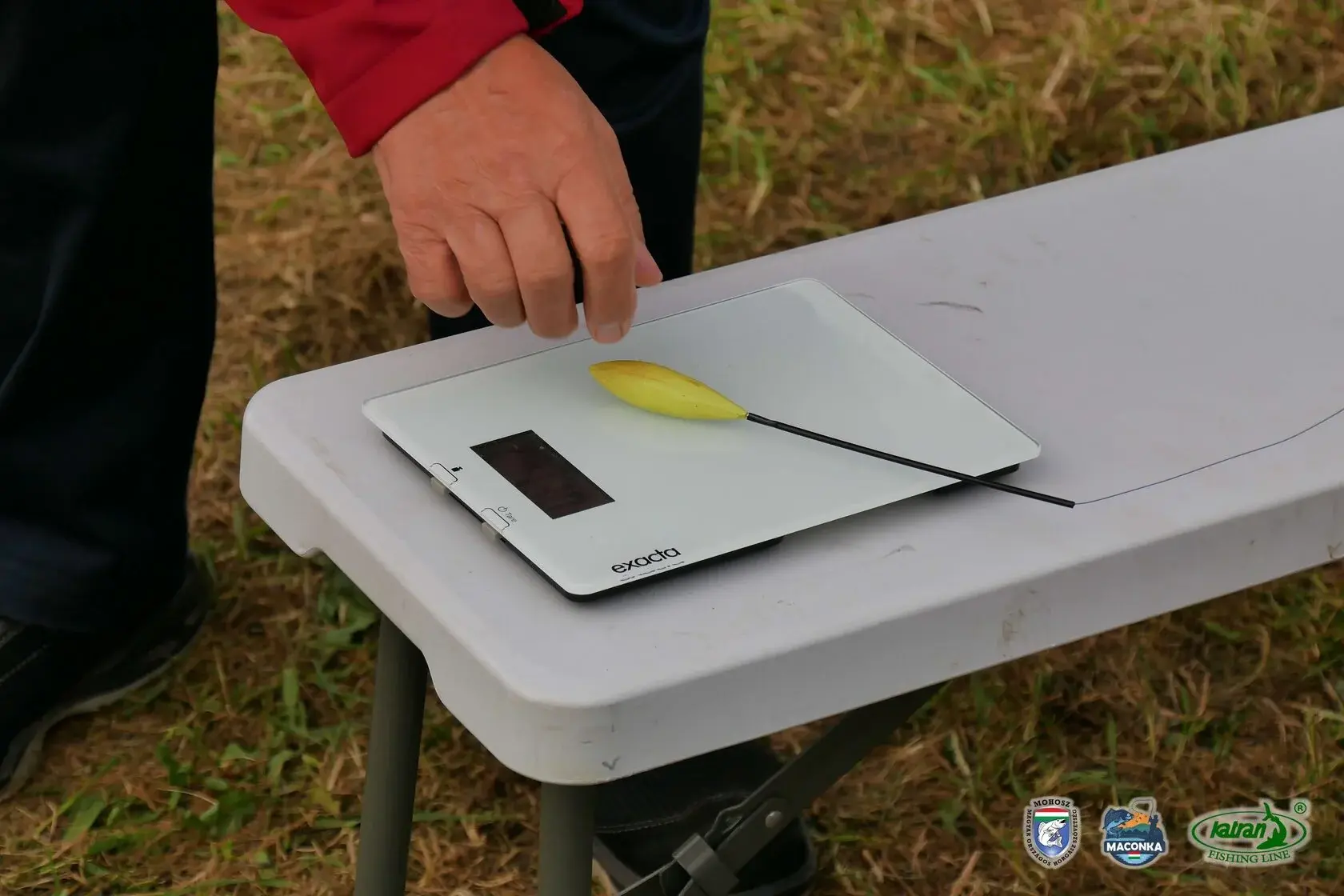
Long-distance casting lead with a rigid tail tube
The lead has to be treated as one system: line → rigid tail tube → lead body.
The equation of distance

What Determines Casting Distance?

In simplified engineering terms, casting distance is the combined result of several factors working against each other:

Distance = f(E0, Fdrag, Fline, Frings, Fspool, Wind)
E0Energy stored in the 4 m rod and transferred to the 130 g lead.
FdragAerodynamic drag acting on the lead itself.
FlineAerodynamic drag from the 0.255 mm KATRAN NEON line.
FringsFriction as the line passes through the rod guides.
FspoolLosses as the line leaves the spool.
WindEnvironmental wind conditions on the day.

The interaction of all of these ultimately decides the maximum casting distance.

Where to look

Where Should We Search for the Ideal Shape?

Today, most lead designs still evolve through trial and error. I think there is a better way. Instead of chasing a shape that merely looks aerodynamic, we should look for one that rotates into its correct flight position as fast as possible, produces minimum drag during high-speed flight, and preserves maximum forward momentum during the final descending phase — when the lead is dragging hundreds of metres of line through the air.

The optimal lead has to be treated as a complete system: line → rigid tail tube → lead body. Only a lead that performs well through all three phases has any chance of approaching the true aerodynamic optimum.

The future of extreme long-distance casting will not depend only on rods, reels or lines — but on how deeply we understand the aerodynamics of the lead itself.

Vitaliy Kremnets, Founder & CEO of KATRAN GmbH
My opinion

I am not claiming I have already found the perfect lead shape. These are my engineering thoughts, and the beginning of a much larger research project.

But I am convinced of one thing: the next real step in extreme distance casting will come from understanding the aerodynamics of the lead — as a system, across all three phases — not from another small tweak to an old shape. That is exactly the journey I intend to continue.

Start with the physics. The shape follows.

Vitaliy Kremnets Founder & CEO, KATRAN GmbH